Industries · Healthcare
Healthcare workplace mental health training for your own staff
Your people spend every shift caring for patients and families. Bedrock Minds trains them to notice and respond to a colleague who is struggling, and to report the workplace hazards behind it.
The work
Psychological hazards in healthcare
In Statistics Canada’s 2023 survey, no industry reported more work stress than health care and social assistance.
Workload
In April 2023, 27.3% of people working in health care and social assistance reported high or very high work-related stress, the highest rate of any industry Statistics Canada reported. Short staffing, extra shifts and rotating nights all add to it.
Violence from patients and families
Ontario’s guide to the law on workplace violence and harassment says workers may face violence from any person in the workplace, including a patient, and that the risk may be higher in sectors such as health care. Being sworn at, grabbed or threatened can become part of an ordinary shift.
Critical incidents
A death, a code, a patient who reminds you of your own family. WSIB’s PTSD presumption covers nurses who directly provide patient care, along with paramedics and other designated workers. Many others on a unit see the same events.
Add the strain of not being able to do everything a patient needs, and the load is heavy. The people carrying it are often the last to say so.
Who notices first
Clinical skill does not make it easier to check on a colleague
Staff who handle crises with patients every day can still hesitate when the person in trouble is the nurse beside them.
The charge nurse sees who has picked up every extra shift for a month. The PSW on the same unit notices a colleague crying in the stairwell. The unit clerk hears the edge in someone’s voice at shift change. In healthcare, as anywhere, the person who notices first is usually a co-worker or a supervisor.
Helping a colleague is different from caring for a patient. There is no chart, no order set and no handover. There is a person you work with, and a conversation you may not have practised.
Bedrock Minds is not clinical training and confers no clinical competence. It teaches a peer response, the 4C Pathway, and every staff member can learn it in the Responder stream: front-line clinicians, support services, clerical staff and managers.
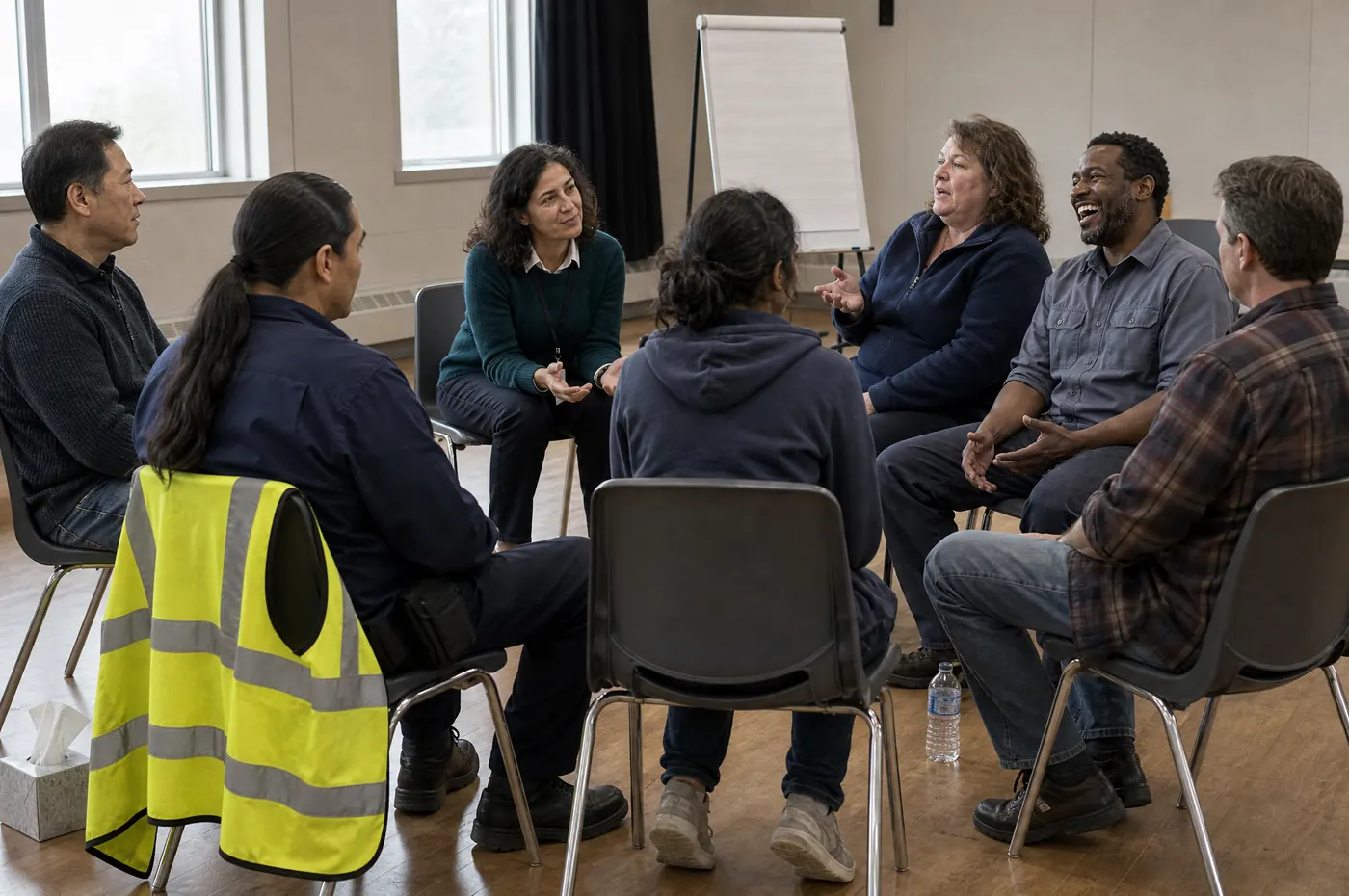
What staff practise
The 4C Pathway for colleagues
The same four steps for a quiet check-in after a hard shift or a crisis in the break room.
Check
The scene, yourself and the person. After a difficult shift, checking yourself first matters. When it is warranted, ask directly about suicide.
Connect
Find a private space off the unit, approach calmly and listen. The skill drilled on the practical day is listening without fixing.
Care
Share what helps, encourage the supports your organization offers or the person’s own doctor, and agree on one next step.
Close the loop
Follow up. Report the workplace hazard, such as a staffing pattern or a gap in violence prevention, rather than the person. Then look after the helper.
Every debrief on the practical day starts with “what zone?” Green, yellow, orange and red give a team shared language for how people are doing after a hard event, without anyone having to disclose more than they choose.
For leaders
Champion for managers, occupational health and the JHSC
Responder builds the skill on the unit. Champion builds the program around it.
Responder is about 5.5 hours of self-paced online modules: foundations, the 13 workplace factors, the 4C Pathway and critical events. Champion is about 10.5 hours across all eight modules, including finding hazards, building the plan and measuring results. Learners pass each module quiz at 80% or better before the practical day.
On the practical day, every learner leads at least two scenarios to standard, including one crisis, in small groups with trained facilitators and actors. Champions also take tabletop and mini-audit roles and write a 90-day plan for their own organization. About Champion
The day often runs at the employer’s own workplace. An education room can work if there are also breakout corners, a separate room with a door for the crisis station, and a quiet room. Groups are capped at 12 learners per pair of facilitators.
Each group builds a de-identified hazard register that leadership and the JHSC can act on. The course is mapped to every normative clause of the voluntary CSA Z1003 standard; it supports your program but does not certify conformance. If you are weighing claims risk, read about WSIB chronic mental stress and employers.
Sources
- Statistics Canada, The Daily: Work-related stress most often caused by heavy workloads and work-life balance (June 19, 2023)
- Government of Ontario, Understand the law on workplace violence and harassment
- WSIB, Operational Policy Manual 15-03-13: Posttraumatic Stress Disorder in First Responders and Other Designated Workers
Build your team’s footing.
Tell us how many people you want to train, which streams, and where your workplace is. We reply within one business day with a quote and available dates.