Industries · Municipal
Municipal workplace mental health training across every department
Roads, water, transit, recreation, by-law and the front counter: one employer, many very different workplaces. Bedrock Minds gives all of them the same four steps for responding to a co-worker who is struggling.
The work
Many workplaces, one employer
A municipality can hold almost every kind of psychological hazard under one roof, or under dozens of them.
Facing the public
Counter staff, by-law officers, transit operators and recreation staff deal with frustrated residents every day. Ontario’s guide to the law on workplace violence and harassment says violence and harassment can come from any person in the workplace, including a client or customer.
Out on your own
By-law officers, inspectors, plant operators on call and parks staff spread across the map often work with little contact with co-workers. The same Ontario guide lists working alone or with just a few people as a factor that may increase the risk of violence.
Emergencies
Floods, storms, water main breaks and fires put crews to work for long hours, often in the community where they live. WSIB’s PTSD presumption covers firefighters, paramedics and workers involved in dispatch, and public works crews see many of the same scenes.
Add public scrutiny of every decision, budget pressure, reorganizations, and a wave of seasonal and student staff every summer. The hazards are real, and they look different in every department.
Who notices first
The crew lead, the counter supervisor, the person in the next truck
Psychological hazards in a municipality are spread out. So are the people best placed to notice them.
A roads foreperson sees the crew every morning. A customer service supervisor knows who took the worst call of the week. A colleague at the arena notices that someone has stopped talking at breaks. HR and occupational health usually hear later, once a problem has become an absence or a claim.
That is why the Responder stream is for all staff, not just leaders. Everyone learns the 4C Pathway:
- Check the scene, yourself and the person. When it is warranted, ask directly about suicide.
- Connect by approaching privately and calmly, and listening.
- Care by sharing what helps, encouraging supports and agreeing on one next step.
- Close the loop by following up, reporting the workplace hazard rather than the person, and looking after the helper.
One sequence across departments means a transit supervisor and a library manager respond the same way, and the hazards they report reach HR and health and safety in the same form.
Critical events
Plan for the day after the emergency
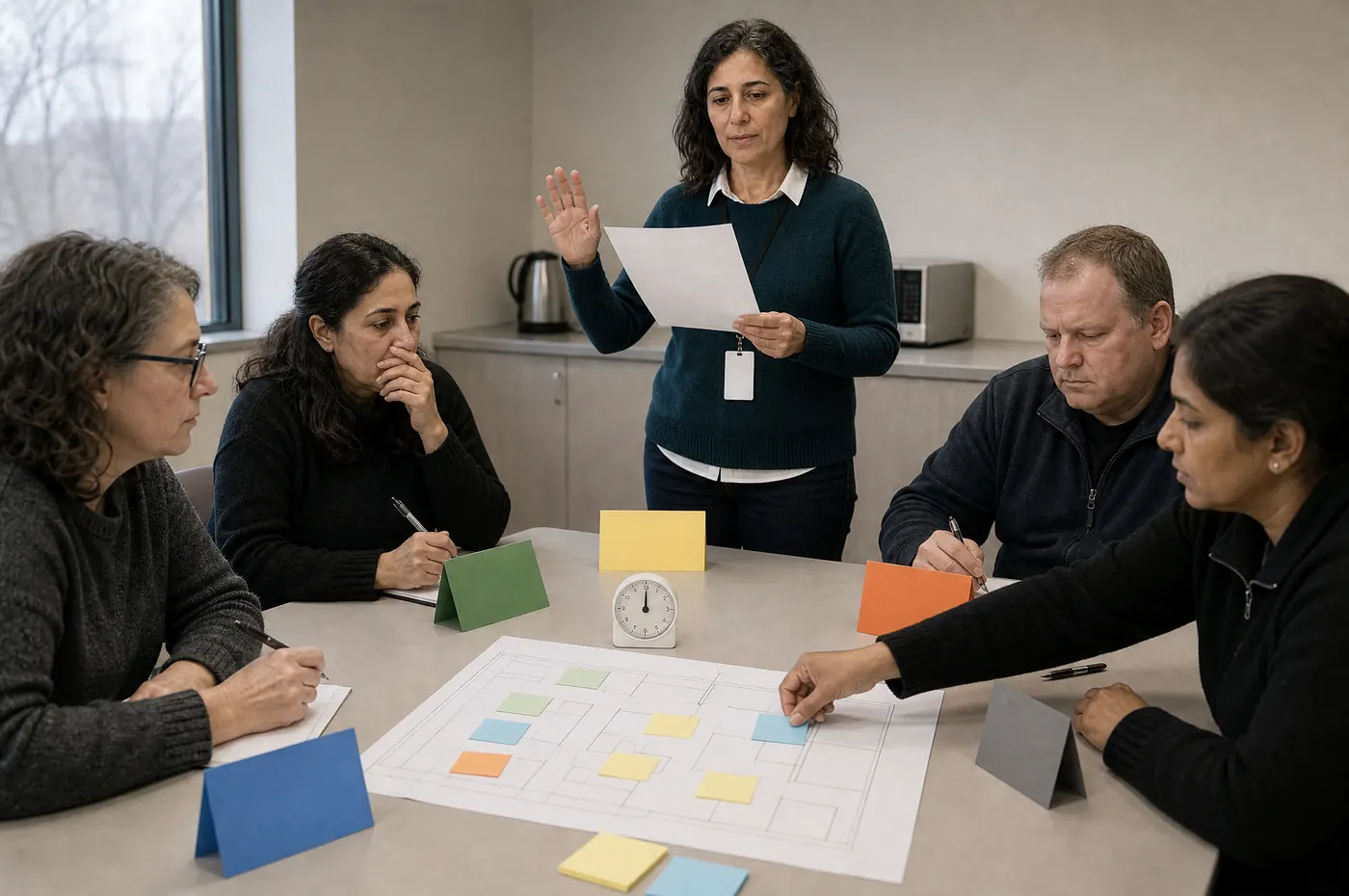
The practical day includes a tabletop exercise on a critical event, so the response to staff is planned before it is needed.
In the tabletop exercise, learners work through a critical event together: who checks on whom, who decides what, and how people get back to work. Champions take tabletop and mini-audit roles, the same skills they will use to run the program afterward.
Every debrief on the day starts with “what zone?” Green, yellow, orange and red give a crew shared language after a hard shift, without anyone having to explain more than they want to.
Each group also builds a de-identified hazard register: the conditions in the work that wear people down, with no names attached. For a municipality with several joint health and safety committees, that gives each one something concrete to act on. See our JHSC page.
Rolling it out
Responder for staff, Champion for the people who run the program
Online modules are self-paced, so staff on every schedule can complete them before the practical day.
Responder: all staff
About 5.5 hours online: foundations, the 13 workplace factors, the 4C Pathway and critical events. Learners pass each module quiz at 80% or better, then lead at least two scenarios to standard on the practical day, including one crisis.
Champion: supervisors, HR, safety, JHSC
About 10.5 hours online across all eight modules, including finding hazards, building the plan and measuring results. Champions leave with a written 90-day plan for their own organization. About Champion
The practical day in your facilities
It often runs at the employer’s own workplace, such as a training room or community space with movable chairs, breakout corners, a separate room with a door for the crisis station, and a quiet room. Groups are capped at 12 learners per pair of facilitators. About the practical day
Bedrock Minds builds skills. It does not replace the workplace violence and harassment policy and program that Ontario employers must maintain, and it does not certify conformance with CSA Z1003. For the wider legal picture, read our article on Ontario employer mental health obligations.
Build your team’s footing.
Tell us how many people you want to train, which streams, and where your workplace is. We reply within one business day with a quote and available dates.