Industries · Manufacturing
Manufacturing mental health training that works with your safety system
Your plant already finds, rates and controls hazards. Bedrock Minds adds the ones you cannot lock out, and trains the operators, leads and committee members who will see them first.
The work
Psychological hazards on the plant floor
They sit in the rotation, the line speed and the way a shift is staffed.
Rotating shifts
The Canadian Centre for Occupational Health and Safety notes that daytime sleep is seldom as deep or refreshing as sleep at night, and that shift workers report more interference with family life than people on straight days. A rotation that never settles wears on mood as well as alertness.
A line that cannot stop
Operators may not be able to step away when something is wrong, and noise makes a quiet word hard. Problems get carried to the end of the shift, or home.
Change and uncertainty
New equipment, new owners, lean staffing, layoffs at the plant down the road. Workers who do not know what is coming bring that onto the floor.
Then there are incidents. When a machine injures someone, the injured worker is not the only person affected. The operator who hit the stop, the lead who called 9-1-1 and the crew who restarted the line afterward all saw it.
Who notices first
The lead hand on nights, not the plant manager on days
Off-shifts see the least of management and the most of each other.
A team lead knows who usually talks at break and who has gone quiet. An operator notices the person at the next station making errors they never used to make. The maintenance tech who covers three lines hears things nobody tells a supervisor. These are the people in a position to act early.
Bedrock Minds gives all of them one sequence, the 4C Pathway. Check the scene, yourself and the person, and ask directly about suicide when it is warranted. Connect by approaching privately and calmly, and listening. Care by sharing what helps, encouraging supports and agreeing on one next step. Close the loop by following up, reporting the workplace hazard rather than the person, and looking after the helper. Operators and leads learn it in the Responder stream.
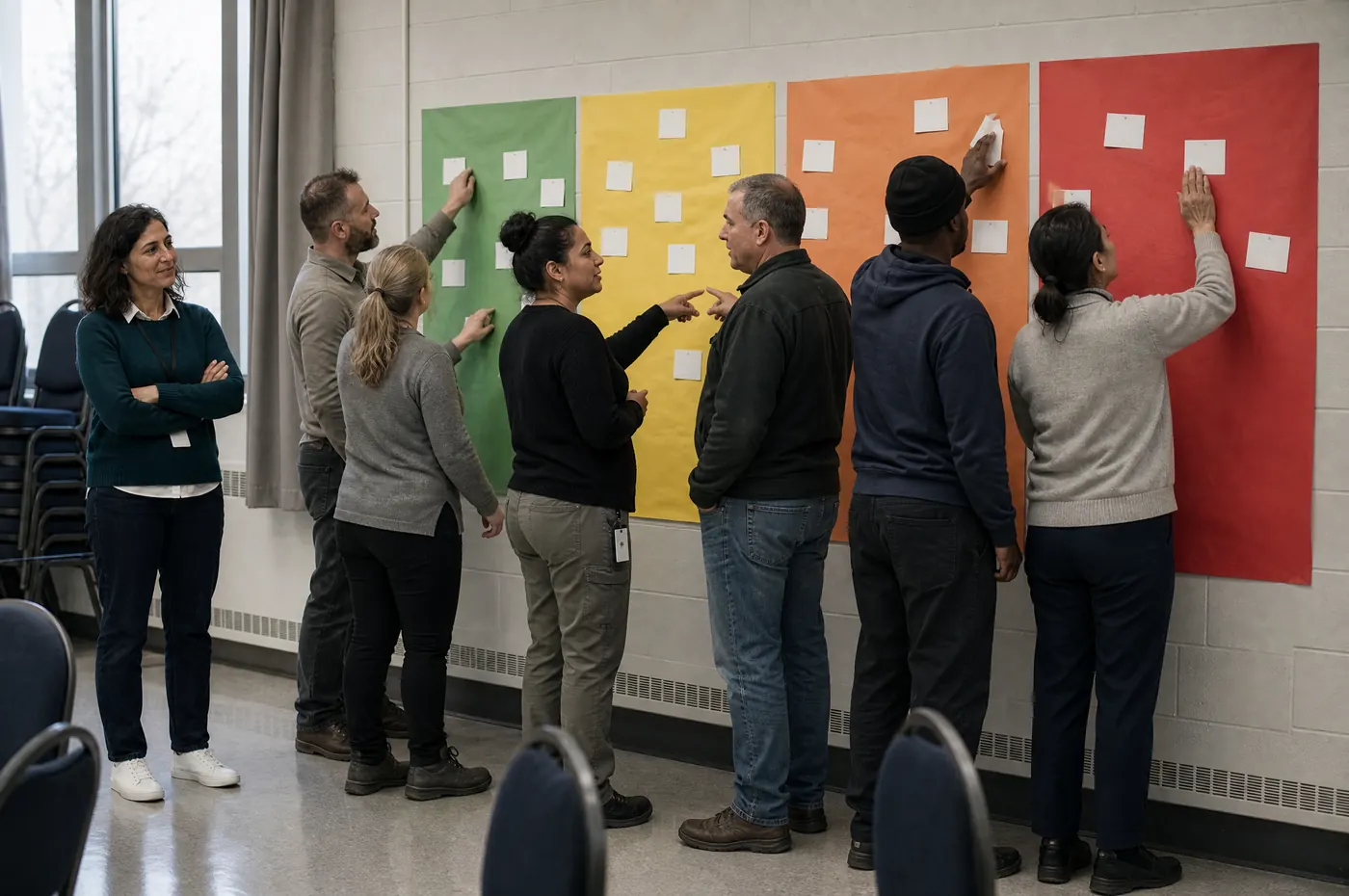
The four zones (green, yellow, orange and red) give a crew shared shorthand for how someone is doing. On the practical day, every debrief starts with “what zone?”
Close the loop
Report the hazard, not the person
This is where the training connects to the system your plant already runs.
Plants are good at hazard registers. Psychological hazards rarely make it onto one. Close the loop changes that: after a conversation, the helper reports what in the work contributed, such as a rotation, a staffing gap or the way a change was announced, and leaves the person’s name out of it.
On the practical day, each group builds a de-identified hazard register from the scenarios and from their own experience. Your joint health and safety committee can take it to the next meeting the same way it takes an inspection finding.
See how this fits the committee’s work on our JHSC page, and read our article on JHSC certification changes in 2026.
Streams
Who takes which stream
Most plants train operators and leads as Responders, and the people who run safety and the program as Champions.
Responder: operators and leads
About 5.5 hours of self-paced online modules: foundations, the 13 workplace factors, the 4C Pathway and critical events. On the practical day, each learner leads at least two scenarios to standard, including one crisis.
Champion: supervisors, HR, safety, JHSC
About 10.5 hours online across all eight modules, including finding hazards, building the plan and measuring results. Champions also take tabletop and mini-audit roles, and write a 90-day plan for their own organization. About Champion
Built against CSA Z1003
The course is mapped to every normative clause of CAN/CSA-Z1003-13/BNQ 9700-803, the voluntary national standard. It supports a program built on the standard. It does not certify your plant’s conformance. About CSA Z1003
The practical day often runs at your own workplace. A training room or lunchroom with movable chairs works if there are also breakout corners, a separate room with a door for the crisis station, and a quiet room. Groups are capped at 12 learners per pair of facilitators. Learners pass each online module quiz at 80% or better first, then rehearse realistic workplace scenes with trained facilitators and actors, practise asking about suicide directly, and work through a critical event in a tabletop exercise.
Build your team’s footing.
Tell us how many people you want to train, which streams, and where your workplace is. We reply within one business day with a quote and available dates.